Each student writes three statements on a topic, two true and one false; the team has to agree on the fiction before the author reveals it. (Teams of four)
Think, Commit, Discuss: this one uses Think, Commit and Discuss.
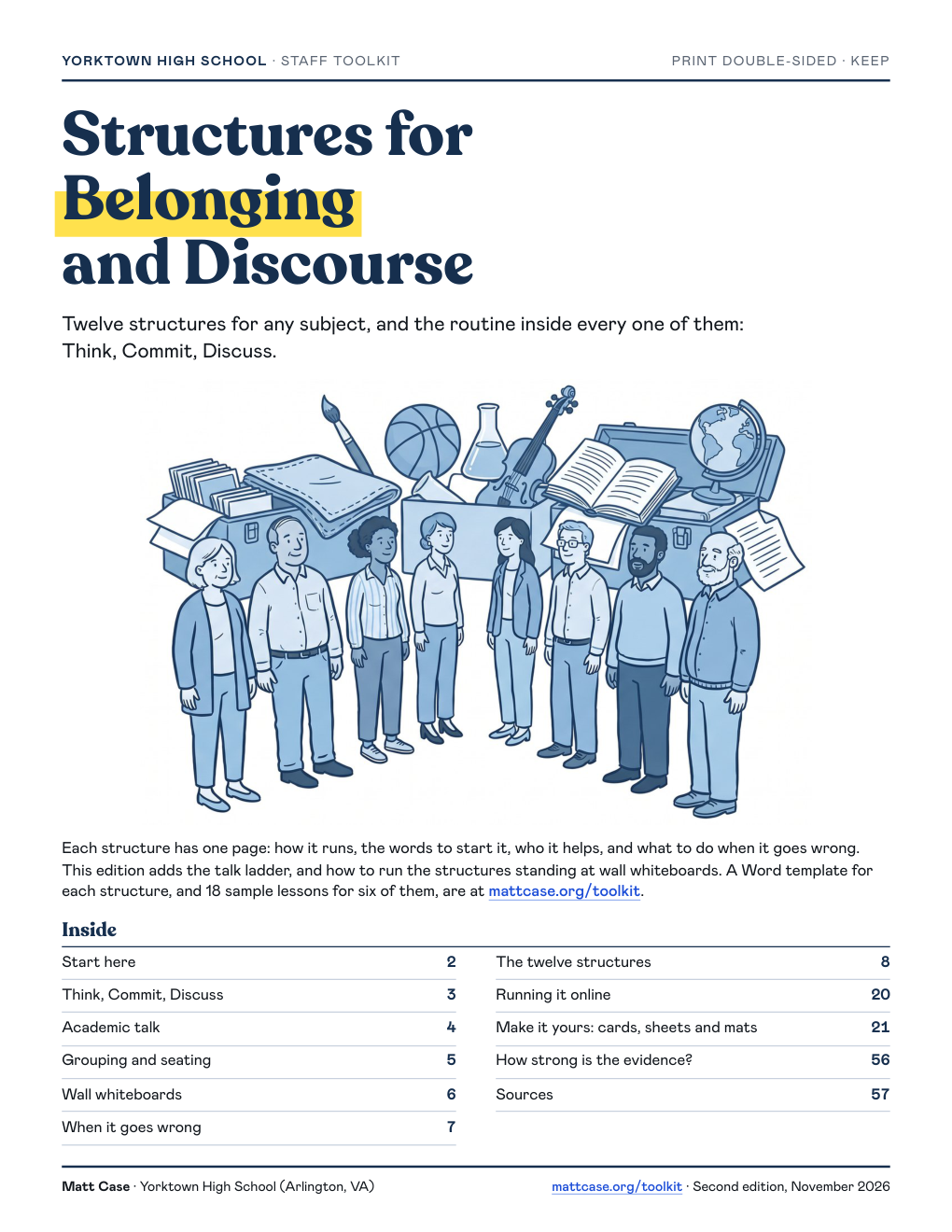
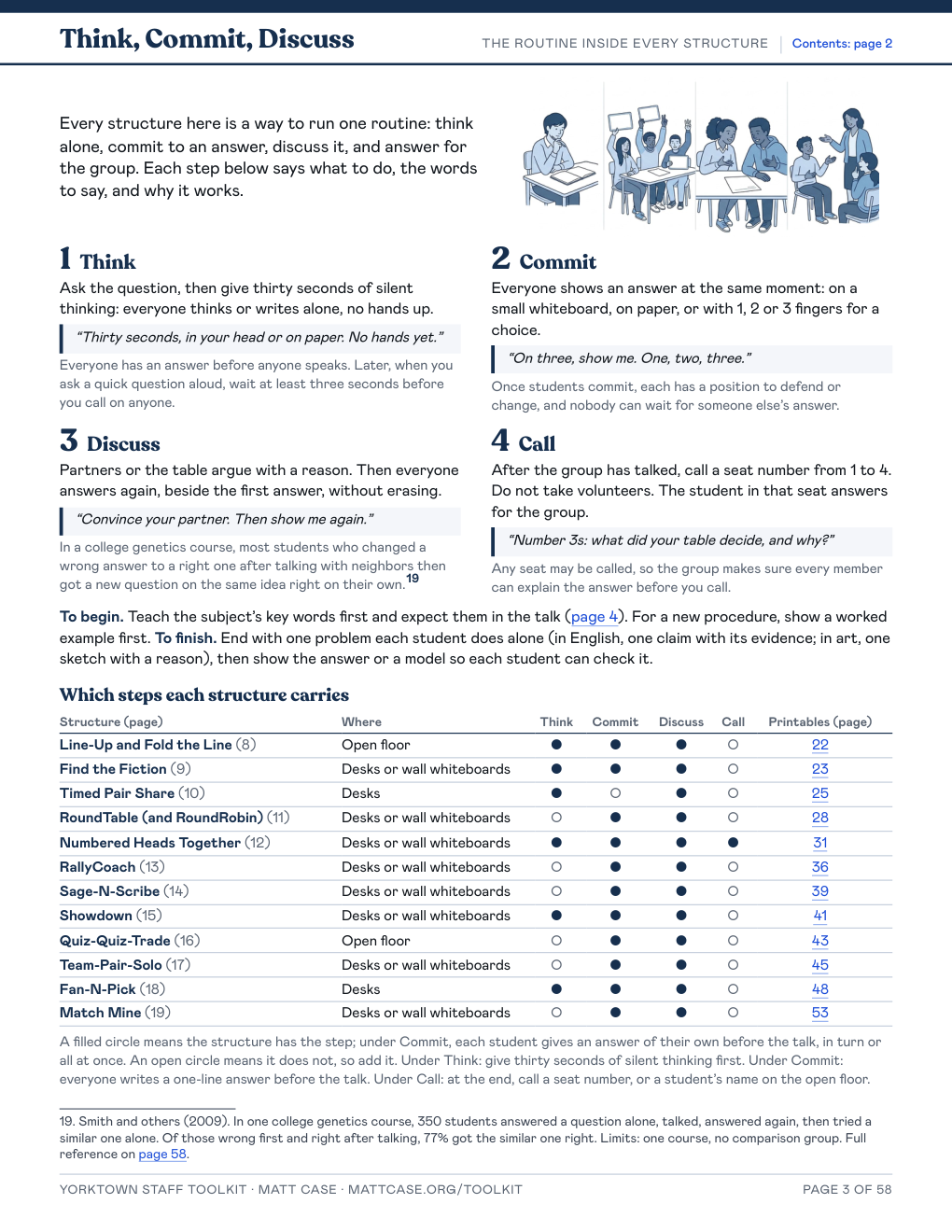
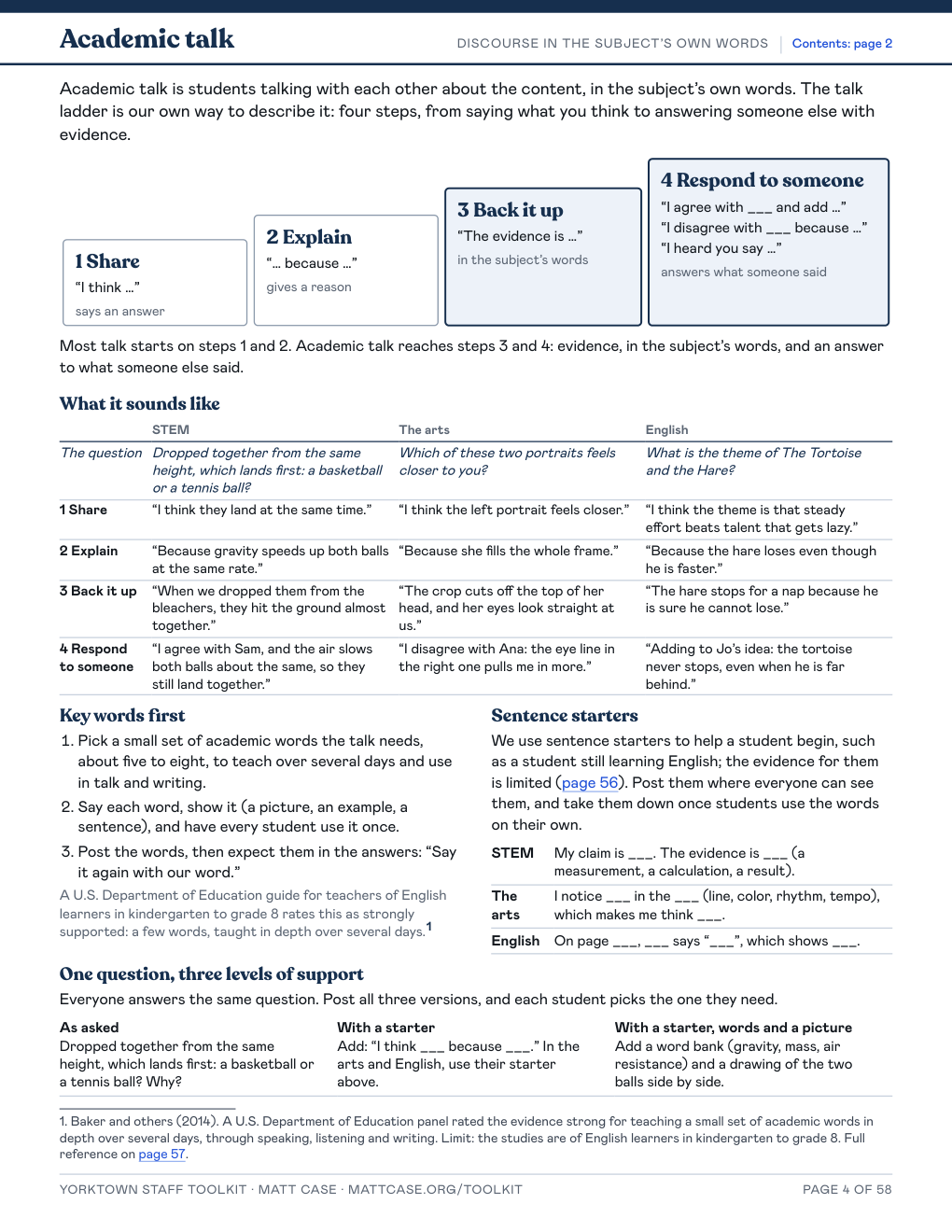
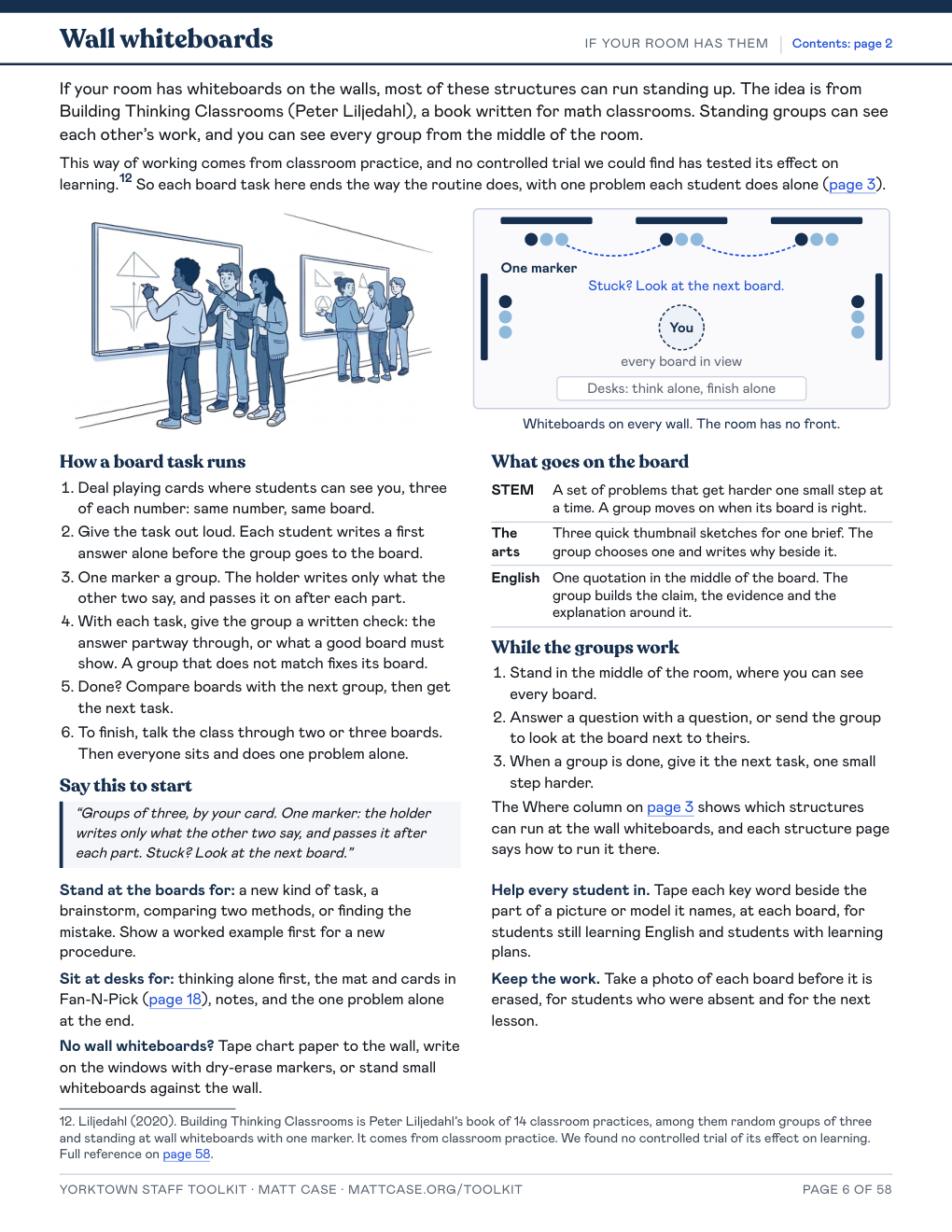
Twelve structures for any subject, and the routine inside every one of them: Think, Commit, Discuss. Built for Yorktown High School staff and shared with any teacher.
A 58-page workbook. Start here helps you pick a structure. Then five pages come before the structures: the routine, the talk, grouping, the wall whiteboards (if your room has them) and what to do when it goes wrong. Each structure has a page of its own, and every card, sheet and mat is ready to print.
Each structure has one page in the toolkit: how it runs, the words to start it, who it helps, and what to do when it goes wrong. Six of them come with sample lessons for STEM, the arts and English.
Each student writes three statements on a topic, two true and one false; the team has to agree on the fiction before the author reveals it. (Teams of four)
Think, Commit, Discuss: this one uses Think, Commit and Discuss.
Teammates take turns adding to one shared sheet (RoundTable) or aloud (RoundRobin). (Teams of four)
Think, Commit, Discuss: this one uses Commit and Discuss.
Teams put their heads together until anyone can answer, then the teacher calls a number. (Teams of four)
Think, Commit, Discuss: this one uses all four steps: Think, Commit, Discuss and Call.
Partners take turns: one solves out loud, the other coaches with questions. Each ends with one problem alone. (Pairs)
Think, Commit, Discuss: this one uses Commit and Discuss.
One partner (the Sage) says each step; the other (the Scribe) writes exactly what the Sage says; they switch each problem. (Pairs)
Think, Commit, Discuss: this one uses Commit and Discuss.
Everyone answers alone on their own whiteboard; on “Showdown!” all reveal at once; the team checks and coaches. (Teams of four)
Think, Commit, Discuss: this one uses Think, Commit and Discuss.
A team solves a problem together, then pairs solve a similar one, then each student solves one alone. (Teams of four)
Think, Commit, Discuss: this one uses Commit and Discuss.
Partners sit with a barrier between them: one describes a card, the other recreates it from the words alone; then they compare. (Pairs)
Think, Commit, Discuss: this one uses Commit and Discuss.
Partners take turns talking for a set time while the other only listens, then the listener thanks them by repeating one thing they said. (Pairs)
Think, Commit, Discuss: this one uses Think and Discuss.
Four jobs rotate around a deck of fold-over cards, the question on one side and the tutor’s steps on the other: one fans, one picks and reads, one answers, one tutors. (Teams of four)
Think, Commit, Discuss: this one uses Think, Commit and Discuss.
Students line up along a scale, then the line folds so each end meets the other. (Whole class)
Think, Commit, Discuss: this one uses Think, Commit and Discuss.
Each student holds a card (question on the front, answer on the back), quizzes a partner, gets quizzed, trades cards and finds a new partner. (Whole class)
Think, Commit, Discuss: this one uses Commit and Discuss.
Each structure’s file is its page from the toolkit, then everything it needs to print (its desk sheet, cards, sheets or mats), with blanks in [brackets] to type over. The Start here file holds pages 3 to 7, the five pages that come before the structures. The 18 sample lessons are with their structures above.